The fork nobody names out loud
A San Gabriel Valley homeowner with a back yard and some equity has two paths: build an ADU, or build ground-up. Most know which one they're building. What they don't know going in is how differently the city treats each one.
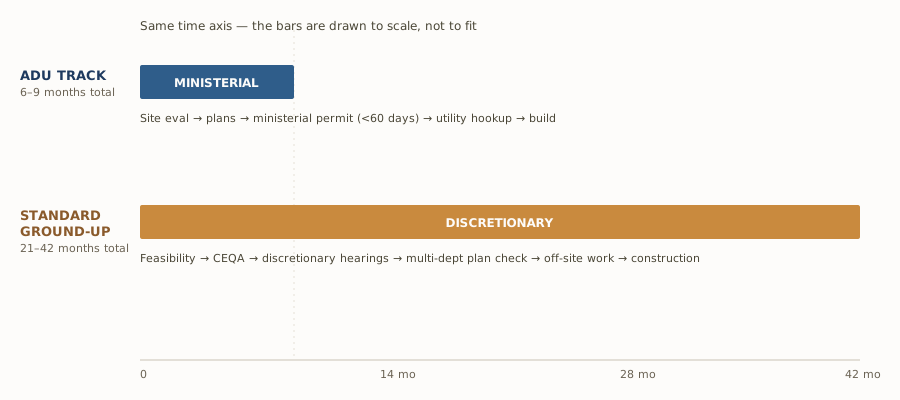
The two differ by a factor of three in time and by an entire category of legal process. An ADU is ministerial: the state took the approval decision away from cities. A standard ground-up project is discretionary — public hearings, design review, and years of process the ADU path never sees.
Both tracks pour the same concrete. The gap between them is entitlement, not construction.
How ADU law got here
State law didn't always treat ADUs this way. A sequence of bills between 2017 and 2026 rebuilt the process from the ground up, phase by phase — verified against the California Legislature's own bill text, not a secondary summary.
| Phase | Years | Bills | What changed |
|---|---|---|---|
| The foundation | 2017 | SB 1069, AB 2299 | Renamed "second units" to ADUs, required ministerial approval standards |
| The expansion | 2020 | AB 68, SB 13 | 60-day ministerial clock; impact fees prohibited under 750 sq ft; utility connection charges eased |
| The financial shift | 2024–2025 | AB 976, AB 1033, SB 1211 | Owner-occupancy requirement permanently eliminated; separate condo sale permitted where cities opt in; detached multifamily ADUs up to 8 units |
| Streamlining | 2026 | SB 543 | 60-day clock now deemed-approved if missed; mandatory 15-business-day completeness review; interior-livable-space size standard |
(AB 434, Ch. 740/2023, effective 2024-01-01, is a housing-element enforcement bill rather than an ADU standards bill on its own — it requires HCD and local agencies to actually enforce the law above. Left out of the phase table since it didn't change a standard, but worth a mention for readers who see it cited elsewhere.)
Ministerial vs. discretionary, side by side
| ADU | Standard ground-up | |
|---|---|---|
| Entitlement | Ministerial (by-right). Staff must approve if objective standards are met — no public notice, no hearing, no CEQA challenge | Discretionary. Public hearings, design review, neighbor notification, CEQA exposure |
| Permit timeline | 2–3 months (60-day state mandate plus a 15-business-day completeness check) | Commonly 12–24 months of entitlement in SGV cities before a shovel goes in the ground |
| Construction | 4–6 months | 9–18 months, depending on size and scope |
| Fees | Exempt from impact fees under 750 sq ft, school fees under 500 sq ft; generally uses existing utility connections | Full impact, park, and utility capacity charges; possible off-site work |
The line that matters: the ADU timeline advantage is not a construction advantage. Both tracks pour the same concrete. The entire gap is entitlement — a legal category the state took away from cities.
SB 9 — the other by-right path
SB 9 lets an eligible single-family lot split into two, with up to two units each — up to four units total, without a discretionary hearing. It's a different mechanism than an ADU (a lot split plus new construction, not an accessory unit on an existing lot), but it belongs in the same "by-right" conversation.
It also runs on the same clock. Both the urban lot split and the two-unit development it enables must be "considered and approved or denied within 60 days from the date the local agency receives a completed application" — and if the city misses that window, the application is deemed approved automatically (Gov. Code §66411.7(b)(1)(B); §65852.21 uses identical language for the two-unit approval). Same 60-day ministerial mechanism as the ADU law, applied to a lot split instead of an accessory unit.
What this means if you're deciding
With an existing house and a back yard, the ADU path is almost always faster and cheaper to entitle — but it caps what you can build. If you need more than an ADU and a JADU can hold, ground-up opens up units at the cost of a process measured in years, not months.
Neither is "better." They answer different questions: how much can I add, versus how fast can I add it.
For SGV-specific setbacks, height limits, fee thresholds, and pre-approved plan programs, start with the ADU resource hub — every San Gabriel Valley city, with its constraint flags. Whichever path you pick, siftAO's design-to-construction Gantt schedule lays out the phases and dependencies on an adjustable timeline. Before you commit to either path on a specific lot, schedule a consultation.